Crime Statistics

Mirfield Crime Rate

+12.0%year-over-year

Crime is increasing and MODERATE in Mirfield

Mirfield's crime rate is 81.3 per 1,000 people, with a safety score of 79/100. Explore detailed crime statistics and trends.

Overall Crime Rate

81.3
Crimes per 1,000 people
increasing trend

Property Crime Rate

24.5
Property crimes per 1,000 people
Includes burglary, theft, vandalism

How Mirfield Compares to UK Average

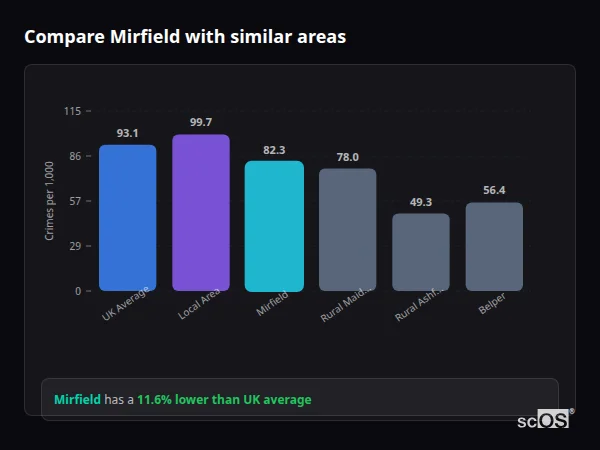
Overall Crime:81.3vs 93.4 UK avg
-12.1 per 1,000 people
Property Crime:24.5vs 33.2 UK avg
-8.7 per 1,000 people

Mirfield's crime rate is significantly lower than UK average

Based on population of 19,689 over 12 months

Crime Statistics Summary for Mirfield

Data last updated: September 2025. Source: Police.uk, ONS, Home Office.

Crime rates per 1,000 people in Mirfield
Overall Crime Rate81.3 per 1,000 people
Property Crime Rate24.5 per 1,000 people
UK Average Crime Rate93.4 per 1,000 people
UK Average Property Crime Rate33.2 per 1,000 people
Safety Score79 out of 100
Population19,689
Trendincreasing
Comparisonsignificantly lower than UK average
Crime Breakdown by Type in Mirfield
Crime TypeTotal CountPer 1,000 PeoplePercentage of Total
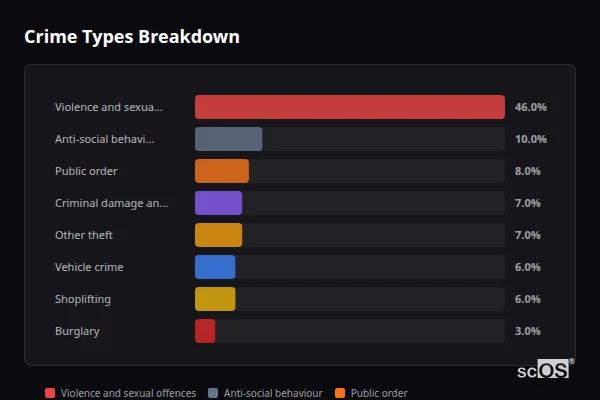
Violence and sexual offences74237.746%
Anti-social behaviour1547.810%
Public order1276.58%
Other theft1075.47%
Criminal damage and arson1075.47%
Vehicle crime1025.26%
Shoplifting944.86%
Burglary532.73%
Other crime472.43%
Drugs3922%
Possession of weapons100.51%
Theft from the person90.51%
Robbery70.40%
Bicycle theft30.10%

Introduction to Crime in Mirfield

Mirfield, with a population of 19,689, reports an overall crime rate of 81.3 per 1,000 residents per year. This figure is lower than the national average of 93.4 per 1,000, indicating a comparatively lower incidence of crime across the UK. The area achieves an impressive safety score of 79 out of 100, which is above the UK average safety score of 78. In terms of recent activity, Mirfield has experienced an increasing crime trend, showing a rise of 12.0% year-over-year. This upward trend suggests a recent increase in crime levels, offering a nuanced picture of safety for residents.

Mirfield Safety Score

79
Safe
Safety Score out of 100

Mirfield has a relatively good safety score compared to the UK average (78).

0-20
20-40
40-60
60-80
80-100

Most Common Crimes in Mirfield

#1

Violence and sexual offences

Percentage:46%
Per 1,000:37.7
Total:742
#2

Anti-social behaviour

Percentage:10%
Per 1,000:7.8
Total:154
#3

Public order

Percentage:8%
Per 1,000:6.5
Total:127
#4

Other theft

Percentage:7%
Per 1,000:5.4
Total:107
#5

Criminal damage and arson

Percentage:7%
Per 1,000:5.4
Total:107

Protect Against These Threats

scOS security systems are designed to detect and deter the most common crimes in your area, providing 24/7 autonomous protection.

Protect Against These Threats

Crime Breakdown in Mirfield

An analysis of crime types in Mirfield reveals that violence and sexual offences are the most prevalent, accounting for 742 incidents, or 37.7 per 1,000 residents, representing 46.4% of all crimes. This is followed by anti-social behaviour with 154 reported crimes (7.8 per 1,000), and public order offences with 127 incidents (6.5 per 1,000). These three categories collectively form a significant portion of the area's criminal activity.

Property-related crime, a key concern for residents and homeowners, combines several categories including burglary, robbery, theft from person, criminal damage and arson, bicycle theft, vehicle crime, other theft, and shoplifting. In Mirfield, the property crime rate stands at 24.5 per 1,000 people per year, which is notably lower than the UK average of 33.2 per 1,000. This suggests that residents may face a comparatively lower risk regarding crimes directly impacting their homes and possessions. Specific figures show 53 burglaries (2.7 per 1,000) and 102 vehicle crimes (5.2 per 1,000), highlighting areas where vigilance remains important for local residents.

Crime Types Breakdown

Violence and sexual offences
742 incidents (37.7 per 1,000)
Anti-social behaviour
154 incidents (7.8 per 1,000)
Public order
127 incidents (6.5 per 1,000)
Other theft
107 incidents (5.4 per 1,000)
Criminal damage and arson
107 incidents (5.4 per 1,000)
Vehicle crime
102 incidents (5.2 per 1,000)
Shoplifting
94 incidents (4.8 per 1,000)
Burglary
53 incidents (2.7 per 1,000)
Other crime
47 incidents (2.4 per 1,000)
Drugs
39 incidents (2 per 1,000)
Possession of weapons
10 incidents (0.5 per 1,000)
Theft from the person
9 incidents (0.5 per 1,000)
Robbery
7 incidents (0.4 per 1,000)
Bicycle theft
3 incidents (0.1 per 1,000)

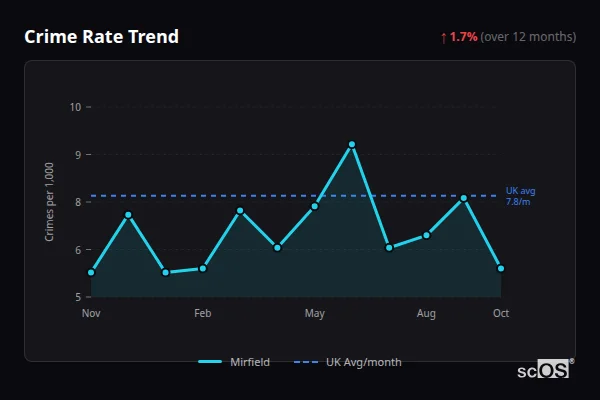
Crime Rate Trend

54% change(over 12 months)
Mirfield
UK Average

Compare Mirfield with similar populations

Mirfield has a 13.0% lower crime rate than the UK average.

Crime Trends in Mirfield

Mirfield has experienced an increasing crime trend over the past year, with a rise of 12.0% year-over-year. This indicates a consistent upward trajectory in criminal activity. Examining the monthly trend data provides further insight into these patterns. The crime rate per 1,000 residents fluctuated throughout the year, starting at 5.0 in October 2024 and generally showing an increase, with a peak of 9.0 in June 2025. There was a notable increase in crime rates during the winter months, with December 2024 reaching 7.3 per 1,000, and a further increase into the summer. Despite some monthly fluctuations, the overall year-on-year increase suggests a need for continued vigilance regarding crime in Mirfield.

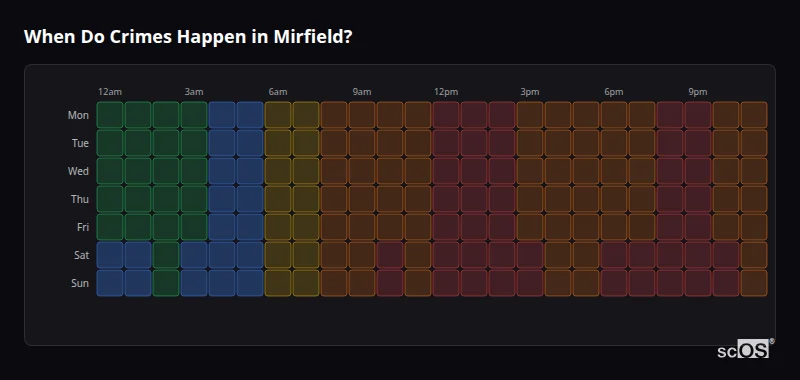
When Do Crimes Happen in Mirfield?

Understanding peak crime times helps you stay vigilant and secure your property when it matters most.

Simulated Data

This heatmap shows estimated crime patterns based on Mirfield's crime statistics, crime type distribution, and general knowledge of when different crimes typically occur. This is not real historical data for specific times.

0
1
2
3
4
5
6
7
8
9
10
11
12
13
14
15
16
17
18
19
20
21
22
23
Monday
Tuesday
Wednesday
Thursday
Friday
Saturday
Sunday
Crime Likelihood:
Very Low
Low
Moderate
High
Very High

Pro Tip: Burglaries peak on weekday evenings (6pm-midnight) and during work hours (10am-3pm) when homes appear empty. scOS smart security stays alert around the clock — detecting threats instantly, whether you're home or away.

What Types of Crime Happen When in Mirfield?

Different crimes occur at different times. This breakdown shows which crime types dominate each time period.

Based on Crime-Type Weighted Model

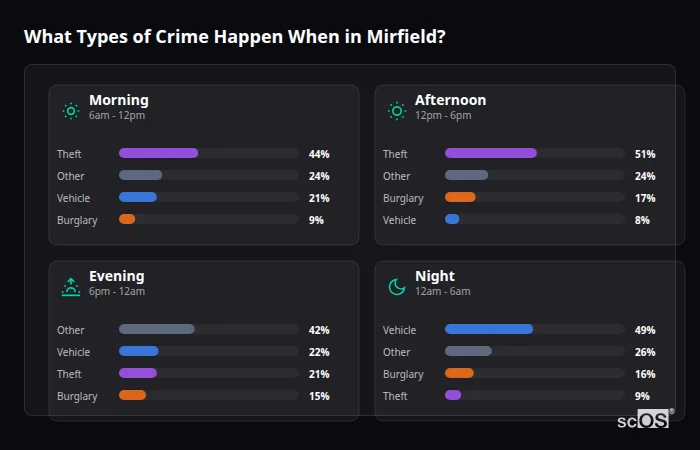
Morning

6am - 12pm

Theft44%
Other24%
Vehicle Crime21%
Burglary10%
Violence0%

Morning hours in Mirfield are dominated by theft and vehicle crime as daily activities commence.

Afternoon

12pm - 6pm

Theft51%
Other24%
Burglary18%
Vehicle Crime8%
Violence0%

Afternoon sees continued high levels of theft and increased burglary during peak activity hours.

Evening

6pm - 12am

Other42%
Vehicle Crime22%
Theft21%
Burglary16%
Violence0%

Evening crime shifts towards other offences, with vehicle crime remaining a significant concern.

Night

12am - 6am

Vehicle Crime49%
Other25%
Burglary17%
Theft9%
Violence0%

Night-time in Mirfield is characterised by a peak in vehicle crime and elevated burglary risks.

Simulated Data - Crime-Type Weighted Model

These crime patterns are estimated using the Crime Survey for England and Wales (ONS) time-of-day data, weighted by Mirfield's specific crime type distribution from Police.uk. This is not real historical data for specific times in Mirfield, but a model-generated estimate based on the area's crime composition and national timing patterns.

Understanding Crime Time Patterns in Mirfield

Crime patterns in Mirfield show distinct variations throughout the day, influenced by the rhythms of community life. During the morning hours (6am - 12pm), theft-related offences are prominent, accounting for 44% of crimes, alongside vehicle crime at 21%, likely coinciding with the opening of commercial areas and increased public activity. The afternoon (12pm - 6pm) sees continued high levels of theft at 51%, and an increase in burglary to 18%, reflecting peak shopping hours and busy streets. As evening approaches (6pm - 12am), the crime landscape shifts significantly; other crime types become the most frequent at 42%, while vehicle crime remains high at 22%, suggesting a change in activity as residents return home. Night-time (12am - 6am) presents a different risk profile, with vehicle crime peaking at 49% and burglary at 17%, indicating that properties are more vulnerable when residents are typically asleep and streets are quieter. These patterns highlight the importance of tailored vigilance depending on the time of day.

Police Response Times in Mirfield

How quickly do police respond to emergencies?

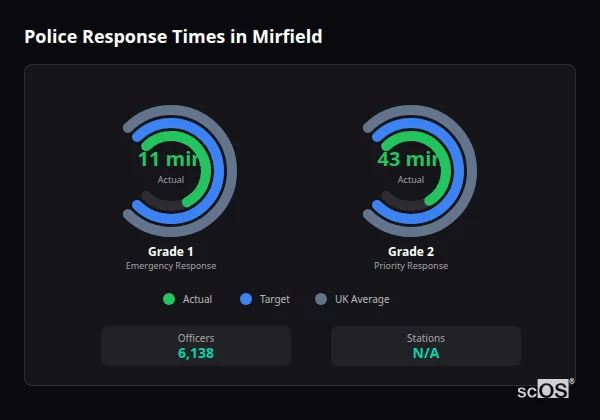
Grade 1 (Immediate)

Emergency 999 calls requiring immediate attendance — crimes in progress, threat to life, or serious injury.

Grade 2 (Priority)

Serious incidents needing prompt response but no immediate threat to life — recent crimes, vulnerable victims.

Grade 1 - Immediate

Emergency Response

11 minActual
Actual
11 min
Target
15 min
UK Average
15 min
4 min faster than target

Grade 2 - Priority

Priority Response

43 minActual
Actual
43 min
Target
1h
UK Average
1h
17 min faster than target

Active Officers

6,138

Each = 500 officers

Police Stations

Pending

Station count data is being collected

Why Response Time Matters

The average burglary takes just 8-10 minutes. Even when police respond quickly, burglars are often gone before anyone arrives.

scOS spots trouble the moment it starts — your lights come on, sirens sound, and you get an alert on your phone. Burglars don't stick around when they've lost the element of surprise.

2024 data
Mean response times
Source: FOI Request

Crime Comparison with Nearby Areas

When considering Mirfield's crime statistics, comparing them to nearby areas provides valuable regional context. Mirfield, as an urban settlement within Kirklees, has an overall crime rate of 81.3 per 1,000 residents, which is lower than the UK average. Nearby Moor Top, Kirkheaton, Liversedge, and Heckmondwike offer a diverse comparison. Mirfield generally presents a more favourable crime profile than some of its more urban neighbours. Moor Top and Kirkheaton, being smaller and often more residential, may have similar or even lower crime rates. Liversedge and Heckmondwike, typically more urban, might exhibit higher rates in certain crime categories. Understanding these local variations helps residents contextualise Mirfield's strong safety score of 79/100 and provides a clearer picture of regional safety.

Why scOS Is Different From Every Other Security System

Traditional systems watch crime happen. scOS stops it from happening.

Sees Everything At Once

AI watches all cameras simultaneously. Never blinks. Never looks away. Impossible to sneak past.

Property line intervention

Knows Every Vehicle

DVLA verification catches fake plates instantly. Suspicious car? You know before they park.

Stop them early

Learns Your Patterns

Recognizes family, delivery times, normal routines. Only alerts you to real threats.

Zero false alarms

Traditional CCTV

  • Records crime as it happens
  • Motion alerts for every shadow, leaf, or car passing by
  • You discover break-in hours later or are in the middle of it
  • Hope police can use the footage

scOS Intelligence

  • Stops threats before they reach your door
  • Intelligent motion alerts — only notifies you of real threats
  • Lights and speakers respond autonomously
  • They turn away before you even know

What used to be impossible is now effortless.

Add the scOS Hub and transform your cameras from recording devices into intelligent protection.

Get Started with scOS

Protecting Your Property in Mirfield

Given Mirfield's property crime rate of 24.5 per 1,000 people, which is lower than the UK average, residents may still wish to consider robust home security measures. Traditional security systems often provide footage after a burglary has occurred, acting reactively rather than proactively. If you are seeking real protection, consider systems designed to prevent crime before it happens. AI-powered home security operating systems, such as scOS, offer a different approach by detecting threats at your property boundary, not just at the point of entry.

These advanced systems leverage multi-camera intelligence to monitor all areas simultaneously, identifying potential intruders without human error. Features like DVLA vehicle verification can instantly flag suspicious vehicles with fake plates, while pattern learning distinguishes between family, deliveries, and genuine threats, reducing false alarms. The goal is to deter criminals within their crucial 60-second decision-making window. With autonomous responses like activating lights and engaging speakers, scOS aims to destroy the element of surprise, making burglars move on. Investing in professional-grade equipment signals serious protection, moving beyond simply recording a crime to actively preventing it.

Ready to stop reading statistics and start protecting what matters?

Understanding Our Data

How we source and verify crime information for Mirfield

4,392+
Areas Covered
19M+
Crime Records
100%
Official Sources

Understanding the Calculations

The crime rate represents the number of recorded incidents per thousand residents in Mirfield. This approach ensures fair comparison regardless of area population size.

Our Information

All statistics come from official government sources: Police.uk provides recorded crime data while the Office for National Statistics supplies population figures. We aggregate data at multiple geographic levels for context.

Formula Used

Crimes per 1k residents = (Total incidents ÷ Population) × 1,000

Our statistics derive entirely from UK government databases:

  • Police.ukCrime records from territorial police forces across England and Wales (43 total)
  • Office for National StatisticsPopulation statistics and the Crime Survey for England and Wales
  • Home OfficeNationwide crime data and official policy records
  • FOI RequestsAdditional statistics obtained via formal requests to police services
Our system covers 4,392+ areas across England and Wales, including major urban centers, towns, and administrative regions. Data for Greater Manchester is currently unavailable. We refresh statistics immediately when official sources publish updates (generally every 8 weeks) and maintain archives for historical analysis.

Contains public sector information licensed under the Open Government Licence v3.0

Last updated: September 2025

New data is released by Police.uk approximately every two months

Spotted incorrect data or something that doesn't look right? Let us know and we'll investigate.